

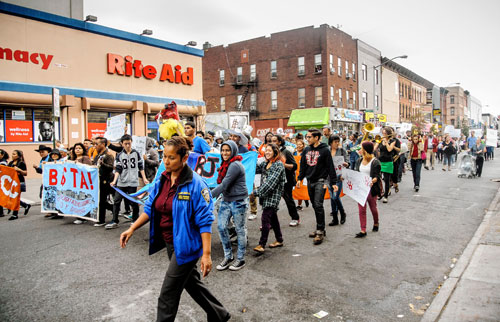
“It is clear that we are in a crisis, I have no rights, and if I lose my business, I lose everything.”
Maria De Los Santos, explaining that she is fighting to keep both her apartment and her Irving Street juice business.
Throughout recent years New York has seen multiple changes from public transit improvement to the overall remodeling of communities like Bushwick. It was predominantly a sicilian community but around the 80’s a transition of more African American’s and Puerto Rican’s. Thought even with the change the situation within the community stayed the same. Bushwick has always had a tight knit community, family owned stores and shops lined the neighborhood, the people were familiar with each other. There was a sense of trust and familiarity with the people living there. The community itself was family oriented that’s what type of neighborhood it was and it stayed like that until recently. In the early stages of 2010 – 2015 it became clear that the community was changing. Out with the old apartments and family stores in with modern high rises and bigger department stores. Now some of these changes could be seen as improvements to the neighborhood but with all the modernization occurring the community went through rent and tax increases. Which led to most of the community struggling to adapt to the sudden demands. This led to a lot of family leaving the area leaving Bushwick a shell of its former self.
It means Bushwick family that have been there for generations are being evicted because rent was too high, or a building was being demolished to make way for something better. The people who have resided in Bushwick are against many of these developments even providing push back trying to sway the government into stopping all these new developments. Bushwick officials and residents unveiled a long-awaited plan on Saturday to shore up the neighborhood against the effects of gentrification and development in the coming years. Not only are they working against the government development they are trying to make rent afordable to help the people. As previously mentioned with the new commercial buildings being built in residential areas there is an increase in rent demand from residents. Among the recommendations, the plan asks for no rezoning from manufacturing to residential, that additional units above what could be built as of right without a rezoning be deeply affordable, and for blocks on residential streets to be preserved.The people of the BCPSC [Bushwick Community Plan Steering Committee] have been trying for years to stop the increase in rent, and the overdevelopment in the area. It took years of time and persuasion to get the opportunity to be heard by government official but they did it.
Brooklynites pushed and pleaded to keep the community the same. This change was not meant for the people within the community but for the people who would move into the community after all the initial remodeling. Bushwick, with about 113,000 residents according to United States Census data, has seen quite a bit of change in recent years. The number of Hispanic residents grew to 73,608, more than 65 percent of the population, in 2010, an increase of 4.9 percent from 2000, with the number of Puerto Ricans declining and Mexicans and Dominicans growing. The number of white non-Hispanics more than tripled from 2000 to 2010, to 9,560, while the number of black non-Hispanics fell by almost 9 percent, to 22,686. With this brief history of the Bushwick community the change of ethnic groups has been great.
Hispanics have been a large part of the community up until recently. Where large masses of Puerto Ricans, Dominicans, and Mexicans have been leaving the community. Why? Because of money of course Bushwick has always been an everyday working class community. When rent became too high above normal working class family standards the people who could not make the cut left. Persuading the people without the use of words. Families could not stay in the community as they were going broke. They needed to find somewhere else to say and to do that they had to move out. Making was for a new wave of people to come in slowly but surely white non-hispanics came to populate the newly renovated area in spades. This development was made possible by driving people out of their communities by targetings their status as a working class citizen in Brooklyn.
 AJ's Discussion
Do you believe Bushwick is going to stay the way it is now or change even more if so why or why not?
LikeLike
Personally I think that Bushwick is going to stay the same seeing as the area itself is still undergoing many changes. Along with all the new buildings and hangouts the people are moving in and out of Bushwick not being able to keep up with the prices. So no I don’t think that Bushwick is going to stay the same and honestly its bound to keep on changing.
LikeLiked by 1 person
i agree and i’m glad it changed in a positive way when it comes to not ad much violence and no as much drug dealing in Bushwick.
LikeLike
Is change in poorer communities something that is really possible?
LikeLike
Yes I’m saying this beacues Bushwick was a relatively bad neighborhood back in the day but it started to change and become the Bushwick we now know. So yes change in poorer neighborhoods is possible Bushwick is proof of that. There are also other communities that can be referred to and poor starting to undergo changes like East New YorK and Crown Heights.
LikeLike